
/ Contact Us
Zhejiang Linchuan Machinery Manufacturing Co., Ltd.
No. 88 Wenbo Road, Jinxi Development Zone, Wucheng District, Jinhua City, Zhejiang Province, China
+86-13605822008
2026-07-10
The crushing sector is beginning to observe subtle yet important shifts in how wear parts respond under extreme loading conditions. Among these components, High-Manganese Hammerheads remain widely used due to their work-hardening ability and impact tolerance. However, changing feed compositions and higher energy crushing environments are revealing fracture patterns that differ from traditional field expectations.
Instead of simple surface wear progression, recent service observations highlight more complex stress redistribution, localized cracking tendencies, and non-uniform deformation zones across hammer surfaces.
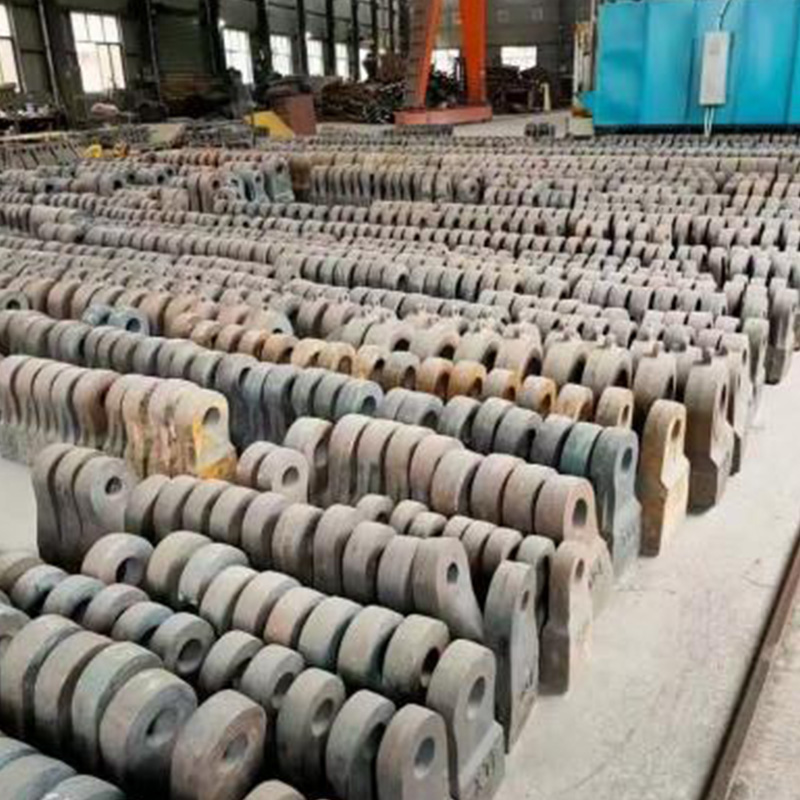
High-manganese steel relies on strain-induced hardening, where repeated impact gradually strengthens the surface layer. This mechanism remains effective, but fracture behavior is now influenced by more aggressive impact cycles and irregular feed hardness.
Metallurgical studies show that high-manganese steels develop a hardened surface layer through dislocation density accumulation and phase transformation, improving wear resistance while preserving core toughness.
Traditional assumptions treat hammer wear as gradual and evenly distributed. Current operating data indicates a more fragmented pattern, especially in high-abrasion crushing lines.
While manganese steel is known for excellent toughness, its performance depends heavily on sufficient impact energy to activate full work-hardening response. Lower or inconsistent impact energy may reduce this protective effect and expose localized weak regions.
Modern crushing systems often process mixed feed materials, including natural rock, recycled concrete, and metallic contaminants. This variability introduces uneven stress distribution across hammer surfaces.
These conditions shift hammer performance away from predictable wear patterns and toward mixed fatigue–abrasion fracture behavior, especially in high-speed rotor systems.
High-manganese steel achieves its durability through a dual behavior: a tough inner core and a progressively hardened surface layer. This combination is effective, but fracture behavior emerges when deformation exceeds stable limits.
Although manganese steels are widely recognized for their strain-hardening capability, their mechanical response is highly dependent on deformation intensity and load continuity during operation.
Design evolution of hammer geometry also plays a role in observed fracture behavior. As crushing demand increases, hammer profiles become more aggressive to improve throughput, which can influence stress concentration points.
Field observations show that hammer imbalance caused by uneven wear can accelerate failure progression by amplifying cyclic stress during rotation.
Rather than relying only on visual inspection, operators increasingly monitor mechanical signals to detect early-stage fracture development in hammer systems.
These indicators often appear before visible cracking, making them useful for predictive maintenance strategies.
To address evolving fracture behavior, development trends are moving beyond traditional single-alloy improvements toward multi-layer and gradient-structured hammer solutions.
These developments aim to stabilize fracture behavior under increasingly variable crushing environments while maintaining the inherent toughness advantages of manganese-based alloys.
High-energy crushing applications are reshaping how High-Manganese Hammerheads behave under long-term service. Instead of uniform wear progression, fracture patterns now reflect a complex interaction between feed variability, impact intensity, and material hardening limits.
This evolution is pushing wear part design toward more adaptive material systems that can respond dynamically to changing mechanical conditions rather than relying solely on static hardness improvements.
HOT PRODUCTS
interested?
Contact us!

No. 88 Wenbo Road, Jinxi Development Zone, Wucheng District, Jinhua City, Zhejiang Province, China

+86-18869925678
+86-13605822008

Mining Crushing & Sand-Making Manufacturer
 English
 中文简体
中文简体
 русский