
/ Contact Us
Zhejiang Linchuan Machinery Manufacturing Co., Ltd.
No. 88 Wenbo Road, Jinxi Development Zone, Wucheng District, Jinhua City, Zhejiang Province, China
+86-13605822008
2026-09-21
Rotor speed often receives attention during impact crushing discussions because it directly affects the velocity of the blow bars and the energy transferred to incoming rock. Yet an impact crusher machine does not produce its final aggregate size through rotor speed alone. Feed size, material hardness, feed rate, impact plate position, blow bar profile, rotor geometry, moisture, and wear condition all influence the material's path through the crushing chamber.
At Linchuan, we look at these variables as connected parts of the crushing process. Our product range includes impact crusher spare parts, high chrome blow bars, impact crusher liner plates, and mining crushing equipment. That product experience gives us a practical perspective on how component geometry and material properties interact with operating parameters.
Our goal is not simply to increase impact energy. We focus on matching the crushing chamber, wear components, feed characteristics, and operating conditions with the required product gradation.
Feed condition establishes the starting point for every impact crushing cycle. A crusher receiving 50 mm material behaves differently from the same machine receiving 150 mm rock. Particle size distribution also matters because a feed containing a large proportion of fines can occupy the crushing chamber differently from a feed dominated by large particles.
Research on impact crusher performance identifies feeding rate, discharge gap, and rotor speed as core variables affecting finished aggregate. A recent DEM study using a PF1315 impact crusher also found that feed rate and discharge gap significantly influence product gradation.
| Feed Factor | Possible Effect Inside the Crusher | What We Review |
| Large feed particles | Higher impact loading | Blow bar material and rotor capacity |
| High fines content | Greater material crowding and repeated contact | Feed screening and chamber loading |
| Wide size distribution | Variable breakage behavior | Feed grading and crusher setting |
| High moisture | Potential adhesion and flow changes | Material condition and feed system |
| Hard abrasive rock | Greater wear on impact components | Alloy and wear-part configuration |
Impact plates, also called aprons or curtains on many horizontal shaft impact crushers, create additional impact zones after material leaves the rotor. Their distance from the rotor influences how long particles remain inside the crushing chamber and how many impact events they experience.
A narrower gap generally keeps particles inside the crushing zone longer, increasing the probability of additional breakage. A wider gap provides a less restrictive path and can allow larger particles to exit earlier. Technical guidance describes apron gap as a primary control for output gradation, while rotor speed acts as another adjustment affecting impact intensity and fines generation.
That distinction matters during commissioning. Changing rotor speed to solve a product-size problem may also change the fines proportion and wear rate. Adjusting the impact plate gap can provide another route toward the required product distribution.
| Impact Plate Position | Material Residence | General Product Direction |
| Wider gap | Shorter crushing path | Coarser discharge |
| Moderate gap | Balanced impact cycles | Intermediate gradation |
| Narrower gap | Longer retention | Finer discharge with more fines |
Actual results depend on rotor diameter, rotor speed, feed size, rock properties, blow bar condition, and the geometry of the individual crusher. A gap value therefore needs to be evaluated together with the rest of the operating configuration rather than treated as an isolated specification.
Material flow rate changes the amount of rock occupying the chamber at any given moment. An impact crusher machine operating with a stable feed receives a more predictable material stream, while large fluctuations can change the loading pattern and product distribution.
Too much material can increase chamber loading and restrict material movement. Too little feed may reduce the frequency of useful material-to-material interactions and leave the rotor operating under a different load condition.
Recent numerical research identified 60–120 t/h as an effective feeding-rate range under the specific test conditions of its study. That figure should not be transferred directly to every impact crusher because machine size, rotor configuration, material type, and chamber dimensions differ.
Blow bars are among the components that directly contact the incoming material. Their working profile determines the geometry of the striking surface, while their material composition determines how they respond to repeated impact and abrasion.
Wear gradually changes that profile. Quarry and crushing-industry guidance notes that product grading can become coarser as impact hammers or blow bars wear and their original shape changes.
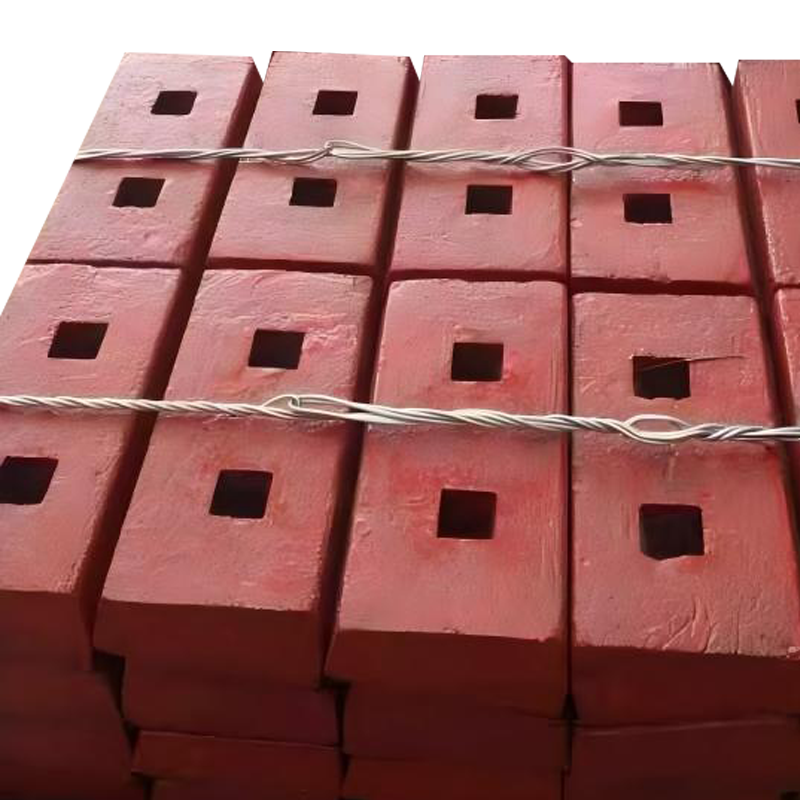
Our impact crusher product range includes high chrome blow bars. We also manufacture other wear-resistant castings based on crusher type and application. Our product information describes high chrome blow bars as critical wear components installed on impact crushers.
That means wear should not be viewed only as a replacement-cost issue. A changing blow bar profile can also change the effective impact geometry, material trajectory, and product gradation.
Rock hardness determines how readily particles fracture under impact. Limestone, granite, basalt, quartzite, and iron ore can create very different working conditions inside the same impact crusher machine.
Hard abrasive rock may require a different blow bar alloy from relatively soft feed. Our own technical work distinguishes between impact-heavy applications and abrasive applications because hardness, toughness, and wear resistance need to be balanced rather than treated as interchangeable properties.
| Material Condition | Primary Wear Concern | Potential Part Direction |
| Soft to medium limestone | Repeated impact and moderate abrasion | Suitable impact-resistant alloy based on application |
| Granite / basalt | High hardness and abrasion | Tough wear alloy with suitable abrasion resistance |
| Iron ore | Strong abrasive action | High-abrasion alloy consideration |
| Mixed recycled material | Impact plus uncrushable inclusions | Toughness becomes particularly important |
High-chrome materials can provide strong abrasion resistance, while manganese-based materials can offer greater tolerance under repeated impact. The correct combination depends on feed size, impact intensity, abrasiveness, and the possibility of tramp material.
Moisture is another variable that deserves attention, particularly with fine material. Damp feed can behave differently from dry rock as it moves through the feeder, chute, and crushing chamber. Adhesion, flowability, and fines distribution can all change.
Our approach is to treat moisture as part of the feed specification rather than an unrelated environmental condition. A material stream containing a high percentage of wet fines may require different feed preparation from dry, well-graded rock.
Rotor speed provides an RPM value, but RPM alone does not describe the actual impact conditions. Rotor diameter affects the linear velocity of the blow bars, while rotor mass and construction influence how the assembly stores and transfers energy.
The relationship can be expressed through a basic tip-speed equation:
Tip speed = π × rotor diameter × RPM ÷ 60
Suppose a rotor has a diameter of 1.4 m and operates at 750 RPM. The theoretical peripheral speed is approximately 55 m/s. A different rotor diameter running at the same RPM will have a different tip speed and therefore a different impact condition.
That is why we avoid treating RPM as a standalone specification. Rotor diameter, blow bar arrangement, feed size, material density, and impact plate position all belong to the same technical discussion.
Impact crushers are often used for applications where particle shape matters alongside size reduction. Repeated impact can break angular material and produce more cubical particles, yet product shape still depends on feed characteristics, chamber configuration, rotor condition, and operating parameters.
A higher reduction requirement usually means greater interaction between the material and impact surfaces. Excessive reduction inside one machine can also increase fines, power demand, and wear. Industry guidance notes that a tighter hammer-to-curtain gap can increase material retention and size reduction while also increasing fines and reducing throughput capacity.
Our focus is therefore on balancing the target product with the crushing duty rather than pushing every parameter toward greater impact intensity.
Wear components are often discussed as consumables, but their geometry directly participates in the crushing process. Blow bars, impact plates, and liner plates form surfaces that determine how rock moves and breaks.
Linchuan supplies high chrome blow bars and impact crusher liner plates, alongside wear parts for jaw, cone, hammer, and other crushing equipment. Our product portfolio includes both high manganese steel fittings and high chromium cast iron fittings.
Different alloys behave differently under impact and abrasion. High-chrome components can provide strong resistance against abrasive feed, while manganese-based materials can offer useful toughness under heavier impact conditions. The choice should reflect the actual feed rather than simply the hardness number of the alloy.
Our technical discussions start with the complete operating picture. A crusher model alone does not provide enough information to understand the expected output.
| Information | Why We Review It |
| Crusher model | Confirms rotor and chamber configuration |
| Rotor diameter and speed | Helps establish impact velocity |
| Feed size | Defines the incoming particle range |
| Feed rate | Defines material loading through the chamber |
| Rock type | Indicates hardness and abrasiveness |
| Impact plate gap | Controls material retention and discharge gradation |
| Blow bar profile | Defines the contact geometry |
| Wear condition | Shows whether original crushing geometry remains |
| Target product | Defines required size and shape characteristics |
This approach allows us to connect equipment configuration with wear-part requirements. A buyer looking for an impact crusher machine can also provide current blow bar specifications, feed characteristics, target product size, and operating conditions. Those details give us a stronger technical basis for discussing the appropriate equipment and replacement components.
Unexpected product gradation does not automatically mean rotor speed is wrong. Several variables can create similar symptoms.
| Observed Output | Possible Factor | Parameter to Review |
| Product becomes coarser | Blow bar wear or wider gap | Bar profile and impact plate position |
| Excessive fines | High impact intensity or narrow gap | Rotor speed and chamber gap |
| Unstable gradation | Variable feed or uneven wear | Feed rate and rotor condition |
| Higher wear rate | Abrasive feed or excessive impact | Rock properties and alloy grade |
| Unexpected oversize | Insufficient impact or unsuitable feed | Rotor condition and feed size |
This framework does not replace machine-specific testing, but it helps separate different causes before making an operating adjustment.
Rotor speed remains an important parameter, but it represents only one part of the crushing equation. Impact plate gap determines how long material remains in the crushing zone. Feed rate changes chamber loading. Feed size affects impact demand. Rock hardness changes fracture behavior. Blow bar profile changes the contact surface. Wear gradually changes the geometry that was present at the start of operation.
At Linchuan, we connect these factors through both equipment and wear-part manufacturing. Our impact crusher components are developed around the actual mechanical demands created by different feed materials and operating conditions. High manganese steel and high chromium cast iron provide different balances of toughness and abrasion resistance, while blow bar and liner geometry remains closely connected to the crushing chamber.
A stable impact crushing result comes from matching several variables rather than relying on rotor speed alone. Feed characteristics, chamber settings, rotor configuration, wear-part profile, and material specification all contribute to the final product. That is the approach we use at Linchuan to evaluate impact crusher machines and their supporting wear components for aggregate, mining, and stone-crushing applications.
HOT PRODUCTS
interested?
Contact us!

No. 88 Wenbo Road, Jinxi Development Zone, Wucheng District, Jinhua City, Zhejiang Province, China

+86-18869925678
+86-13605822008

Mining Crushing & Sand-Making Manufacturer
 English
 中文简体
中文简体
 русский