
/ Contact Us
Zhejiang Linchuan Machinery Manufacturing Co., Ltd.
No. 88 Wenbo Road, Jinxi Development Zone, Wucheng District, Jinhua City, Zhejiang Province, China
+86-13605822008
2026-05-27
Crushing in the cement and aggregate industries.
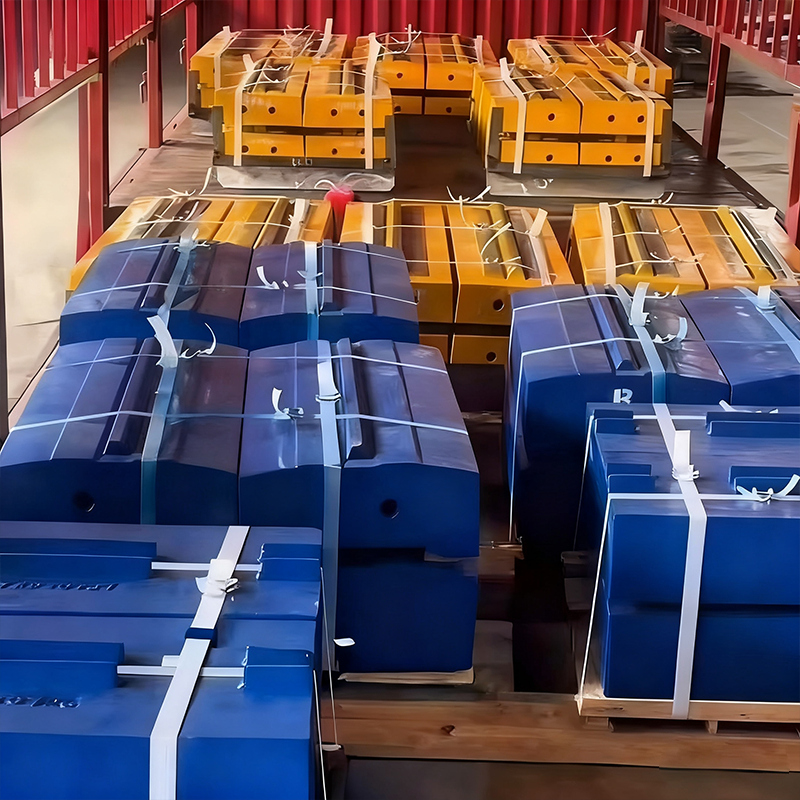
High-chromium white iron hammerheads are used in impact crushers to break limestone, clinker, slag, and other abrasive materials. The high chromium content (typically 12–28% Cr) forms hard chromium carbide particles (M7C3 type, hardness 1,500–1,800 HV) within a martensitic or austenitic matrix. These carbides resist abrasion far better than conventional manganese steel (300–500 HV). A high-chromium hammerhead in a cement plant processing 50 tonnes per hour of limestone may last 200–400 hours before requiring replacement, whereas a manganese steel hammerhead in the same application lasts 60–120 hours. The hammerhead strikes the material at tip speeds of 30–60 m/s. The wear pattern is not uniform: the leading edge (where impact occurs) wears fastest, while the trailing edge (the hammer's back) remains nearly unused. For this reason, many crushers allow hammerhead rotation (turning the hammer end-for-end) to use both edges.
Heat treatment and retained austenite control.
The wear resistance of high-chromium hammerheads depends on the heat treatment. After casting, the hammerhead is austenitized at 950–1,050°C, then air-cooled or oil-quenched. This produces a matrix of martensite (hardness 55–62 HRC) with dispersed chromium carbides. However, some retained austenite (5–25%) remains. Retained austenite is soft (30–40 HRC) and transforms to martensite under impact, which can cause cracking if the transformation occurs too rapidly. For hammerheads used in severe impact (e.g., crushing large boulders), foundries add molybdenum (0.5–2.0%) and copper (0.5–1.5%) to stabilize the austenite and control transformation rate. For hammerheads in low-impact, high-abrasion applications (e.g., fine crushing of slag), higher retained austenite (15–25%) is acceptable because the impact energy is low. After heat treatment, the hammerhead is tempered at 200–400°C to relieve internal stress. Over-tempering (above 500°C) precipitates secondary carbides, raising hardness but reducing toughness.
Failure modes beyond normal wear.
High-chromium hammerheads are brittle compared to manganese steel. The typical impact toughness of high-chromium white iron is 4–12 J/cm² (Charpy V-notch, unnotched specimen), while manganese steel exceeds 100 J/cm². Consequently, hammerheads fail in two additional ways: fracture and thermal fatigue. Fracture occurs when a tramp metal (an unbreakable object like a digger tooth or a steel bar) enters the crusher. The hammerhead cannot deform; it cracks. A single 5 kg piece of steel entering a 100 tonne/hour crusher can break 2–4 hammerheads before the crusher is stopped. Many crushers have metal detectors and magnetic separators to reduce this risk. Thermal fatigue happens when the hammerhead repeatedly heats from friction (surface temperature reaching 300–500°C) and then cools (to ambient) during downtime. After 500–1,000 such cycles, fine cracks (0.1–0.5 mm deep) appear on the hammer face. These cracks grow and eventually spall (flake off), causing rapid weight loss. For continuous operation (24/7/365), thermal fatigue is less of an issue because the hammerhead stays at an elevated, stable temperature.
Abrasiveness of the crushed material – the primary selection factor.
The chromium content of the hammerhead should match the abrasiveness of the material. For mildly abrasive materials (limestone with SiO₂ below 5%, clay, gypsum), a lower chromium content (12–15% Cr) is sufficient. The carbides in 12–15% Cr are about 1,400–1,600 HV, and the material cost is lower. For highly abrasive materials (iron ore, granite, basalt, quartzite, slag), 20–25% Cr is required. The carbides in 20–25% Cr reach 1,700–1,900 HV. For the most severe abrasives (corundum, silicon carbide, very hard quartz), 26–28% Cr is used, often with the addition of vanadium (1–3% V) to form even harder vanadium carbides (2,000–2,200 HV). However, increasing chromium also raises the material's brittleness. A 12% Cr hammerhead may have 10 J/cm² impact toughness; a 25% Cr hammerhead may have only 4–6 J/cm². If the material contains tramp metal or large feed size (over 200 mm), a lower chromium hammerhead is selected despite higher wear rate, because fracture risk is the dominant concern.
Impact energy and crusher type matching.
Hammerheads are used in two main crusher types: hammer crushers (horizontal shaft, hammers pinned to a rotor) and impact crushers (with blow bars). In hammer crushers, the hammerhead pivots on a pin. When it strikes a large rock, the hammer swings back, reducing peak impact force. This "giving" action allows higher chromium content (18–22%) because the impact is cushioned. In impact crushers with rigidly mounted blow bars, the blow bar does not swing; it absorbs all impact force directly. For this application, lower chromium (12–16%) with higher toughness is required. Some impact crushers use high-chromium blow bars with added molybdenum (1.5–2.5%) and nickel (0.5–1.0%) to improve toughness without sacrificing too much wear resistance. The manufacturer's recommendation for maximum feed size and rock compressive strength (typically 100–250 MPa for limestone, up to 300–400 MPa for granite) must be followed.
Operating temperature and thermal cycling.
For crushers operating in hot climates (ambient 40–50°C) or crushing hot materials (clinker at 80–150°C, slag at 100–200°C), the hammerhead's heat resistance matters. High-chromium white iron retains its hardness up to 400–500°C. However, if the hammerhead temperature cycles between 150°C and 50°C every shift, thermal fatigue cracks develop faster. A hammerhead with lower retained austenite (below 10%) is more resistant to thermal fatigue because the austenite does not undergo volume changes during transformation. To reduce retained austenite, the hammerhead is deep-frozen (cryogenically treated at -70 to -196°C) after quenching. This converts retained austenite to martensite. A cryo-treated hammerhead has 2–5% retained austenite and shows 30–50% fewer thermal cracks after 1,000 hours of operation. For hot material crushing (over 200°C), hammerheads with added molybdenum (2–3%) are chosen; molybdenum raises the tempering resistance and reduces softening at high temperatures.
HOT PRODUCTS
interested?
Contact us!

No. 88 Wenbo Road, Jinxi Development Zone, Wucheng District, Jinhua City, Zhejiang Province, China

+86-18869925678
+86-13605822008

Mining Crushing & Sand-Making Manufacturer
 English
 中文简体
中文简体
 русский