
/ Contact Us
Zhejiang Linchuan Machinery Manufacturing Co., Ltd.
No. 88 Wenbo Road, Jinxi Development Zone, Wucheng District, Jinhua City, Zhejiang Province, China
+86-13605822008
2026-09-25
Crusher hammers face very different working conditions depending on the material entering the crushing chamber. Limestone, granite, basalt, iron ore, and mixed aggregate can create different combinations of impact, abrasion, and deformation. Material grade therefore deserves close attention before ordering a High Manganese Steel Crusher Hammer.
Mn13 and Mn18 are both austenitic manganese steels, but their manganese content and work-hardening behavior are not identical. Mn13 generally contains about 11–14% manganese, while Mn18 typically contains around 17–19%. The difference can influence toughness, deformation resistance, and performance under repeated high-energy impacts.
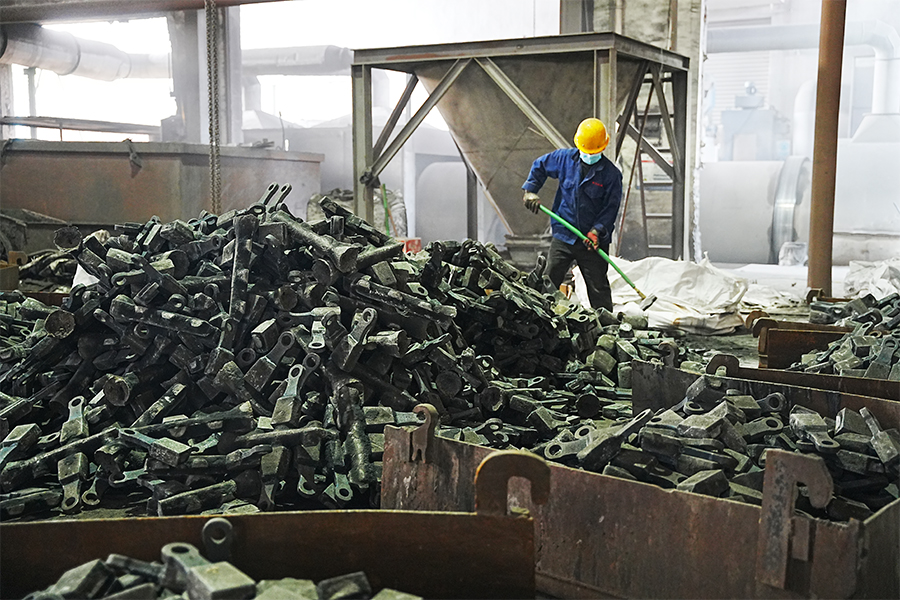
Mn13 has long been used for crusher wear components because it combines a tough austenitic structure with strong work-hardening capability. Its working surface can become substantially harder after repeated impact, while the internal material retains greater toughness.
Large feed particles can generate enough impact energy to activate work hardening. This makes Mn13 a practical material for applications where the feed is abrasive but does not consistently create extremely severe shock loads.
Mn18 raises the manganese content to roughly 17–19%, providing a different balance of toughness and deformation behavior. It is commonly considered for demanding crushing applications involving hard rock, large feed sizes, or repeated high-energy impacts.
Research comparing Mn13 and Mn18-based steels has shown substantial increases in worn-surface hardness after impact-abrasive testing. One study measured worn subsurface hardness above 700 HV for an Mn18Cr2 material, illustrating how deformation and microstructural changes can significantly increase surface hardness during service.
Rock hardness alone does not describe the actual load placed on a hammer. Feed size can be equally important because larger particles can produce stronger impact events.
This point matters for every High Manganese Steel Crusher Hammer. Manganese steel relies on impact-induced hardening, so a very abrasive application with limited impact may require another alloy system rather than simply increasing the manganese grade.
| Factor | Mn13 | Mn18 |
| Manganese content | Approx. 11–14% | Approx. 17–19% |
| Typical feed | Medium-hard materials | Hard and highly demanding materials |
| Impact demand | Moderate to high | High to severe |
| Work hardening | Strong | Strong, with higher Mn content |
| Typical use consideration | General crusher hammer applications | Heavy-impact crushing duties |
Mn13 can make sense for medium-hard feed and applications with consistent impact energy. Mn18 deserves consideration as feed hardness, particle size, impact energy, and abrasive stress increase together. Crusher speed, rotor diameter, hammer weight, crushing chamber design, and actual feed gradation should also be reviewed before finalizing the material specification.
Rather than judging a High Manganese Steel Crusher Hammer by manganese percentage alone, match the alloy to the complete crushing condition. Feed hardness, feed size, impact intensity, and wear pattern together provide a clearer basis for deciding between Mn13 and Mn18.
HOT PRODUCTS
interested?
Contact us!

No. 88 Wenbo Road, Jinxi Development Zone, Wucheng District, Jinhua City, Zhejiang Province, China

+86-18869925678
+86-13605822008

Mining Crushing & Sand-Making Manufacturer
 English
 中文简体
中文简体
 русский