
/ Contact Us
Zhejiang Linchuan Machinery Manufacturing Co., Ltd.
No. 88 Wenbo Road, Jinxi Development Zone, Wucheng District, Jinhua City, Zhejiang Province, China
+86-13605822008
2026-09-23
A rock crusher hammer may look like a simple wear component, but its working surface has a direct relationship with the way material enters, receives impact, breaks apart, and exits the crushing chamber. Material grade determines how the hammer responds to impact and abrasion, while hammer shape influences the contact area, impact position, and development of the working profile during service.
At Linchuan, we consider both factors together. Our range of rock crusher hammer products includes high chrome alloy crusher hammer heads, dual-liquid composite alloy hammer heads, and other wear-resistant components for crushing equipment. We do not treat alloy hardness as the only specification. Crusher type, feed material, hammer geometry, rotor speed, feed size, and expected impact conditions all form part of the technical discussion.
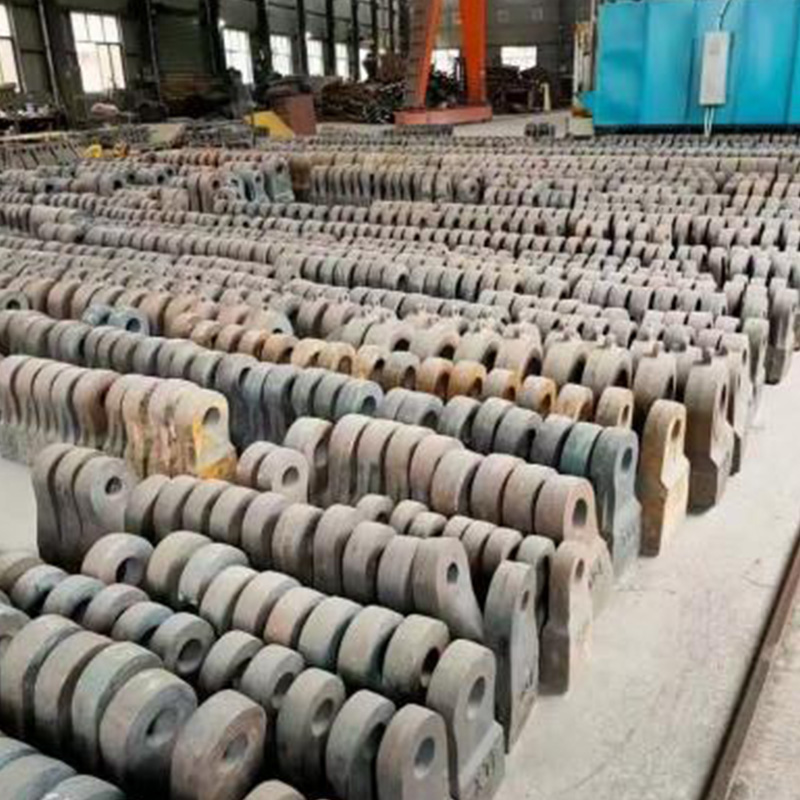
The basic function of a crusher hammer is to transfer impact energy into the incoming material. Yet the amount of useful impact depends partly on the hammer's working geometry.
A broad striking surface can distribute contact over a larger area, while a more concentrated profile can place greater local force on a smaller contact zone. The actual result depends on rotor configuration, hammer mass, speed, feed size, and material properties.
Metso's crushing handbook describes crusher wear-part shape and material as factors that directly influence crusher performance. It also identifies feed distribution, rock characteristics, impact energy, impact angle, impact frequency, and wear-part properties as elements affecting wear behavior.
| Hammer Design Feature | Possible Crushing Effect | Related Consideration |
| Working-face width | Changes the contact area | Feed size and impact intensity |
| Striking profile | Changes the initial contact point | Rock shape and hardness |
| Hammer thickness | Influences mass and wear allowance | Rotor design and casting material |
| Edge geometry | Changes local impact concentration | Material type and application |
| Wear profile | Changes the working surface over time | Feed abrasiveness and service conditions |
Shape cannot compensate for an unsuitable alloy. A hammer receiving repeated high-energy impact needs sufficient toughness, while a hammer processing abrasive rock needs resistance against surface loss.
Our material selection therefore starts with the crushing environment. High manganese steel, alloy steel, high chromium cast iron, and composite materials each offer different combinations of hardness, toughness, and abrasion resistance.
Linchuan's current product range includes high chrome alloy crusher hammer heads and dual-liquid composite alloy hammer heads. We develop these products around different wear conditions rather than treating every rock crusher hammer as an identical casting.
Metso's technical documentation distinguishes manganese steel from high-chrome white iron partly through this balance. Manganese can work harden under suitable impact conditions, while high-chrome white iron provides strong abrasion resistance but has greater limitations under severe impact.
Hammer design should correspond to the size of the material entering the crusher. Large rock creates a different contact event from smaller, already-crushed particles.
Large feed can produce concentrated impact on the hammer surface. Smaller feed creates more frequent contact and can increase the proportion of abrasive sliding or repeated impacts. Our technical analysis of crusher spare parts also identifies feed size as a major factor affecting wear behavior. Oversized feed can create higher localized impact loads, particularly on impact-oriented wear components.
| Feed Condition | Hammer Challenge | Design Focus |
| Large rock | High instantaneous impact | Toughness and structural strength |
| Medium feed | Repeated impact | Balanced hardness and toughness |
| Small abrasive particles | Continuous surface wear | Abrasion resistance |
| Mixed-size feed | Changing impact conditions | Balanced material and profile |
| Tramp metal risk | Sudden shock loading | Toughness and fracture resistance |
This is why we ask about maximum feed size and feed distribution before discussing a hammer specification.
Granite, basalt, limestone, quartz-rich rock, coal, and recycled concrete place different demands on a hammer. The word “rock” alone does not tell us enough about the working environment.
Granite and basalt can combine hardness with abrasion. Quartz-rich feed can produce particularly aggressive surface wear. Limestone may create a different balance of impact and abrasion. Recycled concrete introduces another variable because embedded steel can produce sudden impact events.
Our recent analysis of mining crusher parts shows why static rock hardness does not provide a complete material-selection answer. Hard ore can create abrasive wear, impact damage, localized stress, and profile changes at the same time.
| Material | Typical Concern | Hammer Property to Review |
| Granite | Hardness + abrasion | Toughness and wear resistance |
| Basalt | Hard, dense feed | Impact resistance and abrasion resistance |
| Limestone | Moderate abrasion | Balanced hardness and toughness |
| Quartz-rich rock | Severe abrasion | Abrasion-focused alloy |
| Recycled concrete | Impact + steel contamination | Toughness and fracture resistance |
A new hammer does not retain its original geometry throughout its working life. Material removal gradually changes the striking surface, edge shape, and overall profile.
That change matters because the hammer is part of the crushing geometry. A worn surface can change the point at which material receives impact. It can also alter the balance of material flow around the rotor.
Metso notes that wear-part shape can affect crusher capacity, discharge gradation, and power draw, while its wear guidance identifies crusher parameters, feed characteristics, and wear-material properties as connected factors.
We therefore view hammer wear as more than a question of remaining thickness. The changing profile itself deserves attention.
Rotor speed influences impact velocity, but the actual crushing event depends on several variables. A hammer mounted on a large-diameter rotor at a particular RPM can have a different peripheral velocity from a smaller rotor operating at the same RPM.
The basic relationship can be expressed as:
Hammer tip speed = π × rotor diameter × rotational speed ÷ 60
Consider a 1.2 m rotor operating at 800 RPM. Its theoretical peripheral speed is approximately 50.3 m/s. Changing the rotor diameter to 1.5 m at the same speed raises the theoretical peripheral velocity to approximately 62.8 m/s.
Actual material velocity and energy transfer depend on the complete rotor and crushing system. Still, the calculation shows why RPM alone cannot describe hammer impact conditions.
Hammer mass affects the energy available during impact. A simplified kinetic-energy relationship is:
E = ½mv²
Here, m represents hammer mass and v represents velocity. Increasing either value changes the theoretical kinetic energy, although actual crushing energy transfer is affected by rotor design, material contact, collision angle, and other losses.
That creates an important connection between shape and material. A thicker or heavier hammer changes mass, while a different alloy can change density, hardness, toughness, and structural behavior. Geometry therefore has mechanical consequences beyond the visible working face.
High chromium cast iron is widely used for wear components that face strong abrasion under controlled impact conditions. Its hard carbide structure can resist material removal effectively.
Our high chrome alloy crusher hammer heads are developed around this type of application. They are suitable for certain abrasive feed conditions, yet we do not recommend treating high chrome as a universal solution.
Large rocks, tramp metal, or severe shock loads can change the suitability of a hard but comparatively brittle alloy. Our technical guidance distinguishes high-chrome iron from manganese systems because each material responds differently to impact and abrasion.
| Operating Condition | Possible Material Direction | Reason |
| High abrasion + controlled impact | High chrome | Strong resistance to abrasive wear |
| Heavy repeated impact | Manganese / tough alloy | Greater tolerance to shock loading |
| Mixed abrasion + impact | Alloyed or composite material | Balance between competing wear mechanisms |
| Uncrushable material present | Tougher material system | Lower fracture risk under sudden loading |
Composite hammer designs provide another route. Instead of relying on one material throughout the component, different regions can be engineered around different working demands.
Our dual-liquid composite alloy hammer heads represent this type of approach. The concept allows the working area and supporting structure to have different material characteristics, creating a balance between surface wear resistance and structural toughness.
This approach can be useful for applications where the hammer needs strong abrasion resistance at the working face but cannot sacrifice the structural integrity required under impact.
It would be misleading to ask whether hammer shape or material is more important in every application. Their effects are connected.
| Factor | Primary Influence | What We Examine |
| Hammer shape | Contact geometry | Striking surface, thickness, edge profile |
| Hammer material | Wear and fracture behavior | Hardness, toughness, alloy composition |
| Rotor speed | Impact velocity | RPM and rotor diameter |
| Feed size | Impact loading | Maximum size and distribution |
| Rock properties | Breakage and abrasion | Hardness, toughness, abrasiveness |
| Hammer wear | Changing profile | Wear location and remaining geometry |
Metso's wear-part guidance supports this system-level view. Its documentation lists rock type, hardness, toughness, impact energy, impact angle, impact frequency, wear material composition, hardness, toughness, and manufacturing quality among the variables affecting wear behavior.
Our development process begins with the crusher and feed rather than starting from a standard hammer shape. We review the working environment and then determine the material and geometry that fit the application.
Our facility focuses on mining crushing, sand-making, and wear-resistant castings. We manufacture high manganese steel and high chromium cast iron components, while our product portfolio covers hammer crusher parts, impact crusher parts, cone crusher parts, and jaw crusher parts.
Consider two hypothetical hammers used on the same crusher. Hammer A uses a suitable alloy but has a profile that does not match the feed condition. Hammer B has a suitable geometry but uses a material that cannot tolerate the impact level. Neither configuration fully addresses the application.
| Configuration | Potential Issue | Why |
| Suitable material + unsuitable shape | Irregular impact pattern | Contact geometry does not match the crushing duty |
| Suitable shape + unsuitable material | Rapid wear or fracture | Material properties do not fit the loading condition |
| Suitable shape + suitable material | More consistent working condition | Geometry and wear properties support the same application |
| Suitable shape + material + feed | Application-specific configuration | Crusher, rock, hammer, and operating parameters are aligned |
This is why we avoid making material recommendations without asking about the crusher and feed. The same hammer alloy can behave differently under two feed conditions, just as the same geometry can produce different results with different materials.
Buyers searching for a replacement rock crusher hammer can provide several technical details to make the matching process more precise.
Photos of the existing hammer can also help us understand the working profile and wear distribution. Dimensional drawings, part numbers, and previous casting specifications provide additional references for OEM or replacement production.
We see hammer design as a combination of geometry, alloy, rotor conditions, feed characteristics, and wear behavior. Material determines how the component responds to abrasion and impact, while shape determines how the component interacts with the rock.
A hard alloy cannot correct an unsuitable profile. A well-designed profile cannot compensate for insufficient toughness. Rotor speed cannot be evaluated separately from rotor diameter and hammer mass. Even a suitable new hammer changes gradually as its working face wears.
At Linchuan, we use this broader view to develop high chrome alloy hammer heads, dual-liquid composite alloy hammer heads, and other crusher wear components around actual crushing conditions. Our aim is to match the hammer with the machine and material rather than treating every replacement part as a standard casting.
Shape determines how the hammer meets the rock; material determines how the hammer withstands that meeting. A practical rock crusher hammer needs both sides of the equation to work together. Reviewing the feed size, rock properties, rotor configuration, hammer geometry, alloy composition, and existing wear pattern gives us a much clearer basis for developing the right component for a specific crushing application.
HOT PRODUCTS
interested?
Contact us!

No. 88 Wenbo Road, Jinxi Development Zone, Wucheng District, Jinhua City, Zhejiang Province, China

+86-18869925678
+86-13605822008

Mining Crushing & Sand-Making Manufacturer
 English
 中文简体
中文简体
 русский