
/ Contact Us
Zhejiang Linchuan Machinery Manufacturing Co., Ltd.
No. 88 Wenbo Road, Jinxi Development Zone, Wucheng District, Jinhua City, Zhejiang Province, China
+86-13605822008
2026-06-19
High-Chromium Hammerheads are widely applied in impact crushers and hammer mills where abrasive rock and mineral materials are broken under high-speed rotation. These components are engineered for wear resistance, yet field performance sometimes shows premature fracture rather than gradual abrasion. Failure analysis reports in mining and mineral processing indicate that the root cause is rarely single-point material weakness, but a combination of impact fatigue, structural brittleness, and unstable working conditions.
Crushing environments rarely remain constant, which means hammerheads experience alternating stress states rather than steady loading. This difference plays a major role in early breakage behavior.
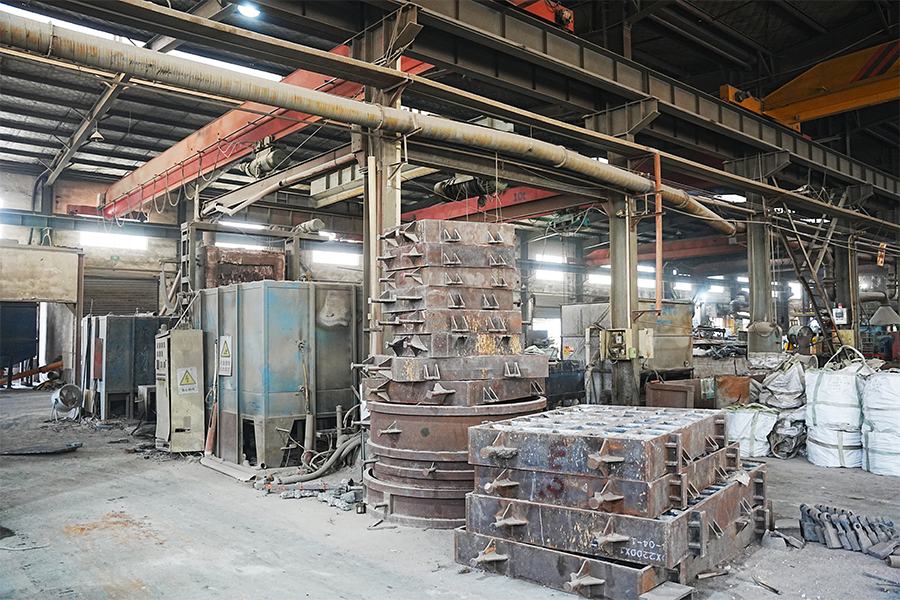
High-chromium alloy hammerheads rely on hard carbides embedded in a martensitic matrix to achieve wear resistance. While this structure improves abrasion resistance, it also reduces tolerance to sudden impact shocks.
Key technical characteristics:
When carbide distribution is uneven, stress concentrates at boundary interfaces. These localized weak zones become initiation points for micro-cracks during repeated impact cycles.
Hammer crushers operate under continuous high-velocity rotation, often between 800–1200 rpm depending on application. Each rotation introduces repeated impact cycles between hammerhead and material feed.
Stress behavior patterns:
Over time, microscopic cracks develop internally. These cracks may remain stable for a period before accelerating rapidly once they reach a critical length. This explains why failure sometimes appears sudden even though damage has been progressing internally.
Unexpected hard objects in the feed material significantly increase fracture probability. These include metal fragments, excavator teeth, or oversized rock blocks.
Observed operational impacts:
Industry field reports highlight that a single overload event can shorten hammer life dramatically compared to normal abrasive wear cycles. Once structural integrity is compromised, subsequent impacts propagate existing cracks much faster.
Manufacturing conditions strongly influence hammerhead durability. High-chromium cast iron requires controlled heat treatment to achieve a stable balance between hardness and toughness.
Critical heat treatment factors:
Even minor inconsistencies can introduce internal stress gradients. These stresses may not be visible externally but significantly reduce resistance to dynamic impact loading during operation.
Hammerhead geometry plays an important role in stress distribution. Areas with abrupt section changes are especially vulnerable.
Common weak zones include:
Once stress accumulates at these points, crack initiation occurs more easily under cyclic loading. Crack propagation typically follows the direction of maximum tensile stress until final separation occurs.
Field environments introduce variability that laboratory testing cannot fully replicate. This mismatch often explains early breakage in real applications.
Key external factors:
Such conditions create fluctuating stress cycles rather than stable loading, which accelerates fatigue accumulation in High-Chromium Hammerheads.
Although fracture may appear sudden, several warning signs usually develop beforehand:
These signals reflect internal fatigue growth rather than simple surface wear. Monitoring them helps operators identify degradation stages before complete failure occurs.
HOT PRODUCTS
interested?
Contact us!

No. 88 Wenbo Road, Jinxi Development Zone, Wucheng District, Jinhua City, Zhejiang Province, China

+86-18869925678
+86-13605822008

Mining Crushing & Sand-Making Manufacturer
 English
 中文简体
中文简体
 русский